
Nassau County Jail Mugshots Overview
A mugshot is the photo taken at the booking desk when someone is processed into jail. In Nassau County, that booking happens at the Nassau County Jail & Detention Center in Yulee, which the Nassau County Sheriff's Office runs through its Division of Corrections. The sheriff publishes an online inmate search that the public can use to check who is held. The NCSO Corrections page says that search shows current in-custody status and bond information. It does not state on that page whether a booking photo is part of each result.
Because the live portal could not be inspected directly, this site does not promise that every Nassau County roster entry carries a public mugshot. If a photo is shown when you open a record, it appears with the active in-custody profile. If no photo appears, or the search is down, the way to obtain a booking image is a public-records request to the sheriff. There is no separate recent-bookings gallery or daily booking report documented on the official NCSO pages, so the inmate search and a records request are the two reliable channels.
Where to Find Nassau County Booking Photos
The official channel always comes first. Start with the NCSO inmate search portal, which is the county's current in-custody lookup. It is free and linked straight from the sheriff's Corrections page. If the portal is offline, blocked, or returns no image, the fallback is the Records Department, which handles public-records requests for booking material that is not online. The booking desk can also confirm whether a recent arrest has finished intake, since a very new booking may not appear right away.
- Open the NCSO inmate search from the sheriff's Corrections page and follow the fields shown on the live portal.
- Enter the person's name as it appears on the arrest notice, then run the search.
- Open the matching in-custody record to view the bond and status details; a booking photo will appear here only if the live portal displays one.
- If no photo shows or the search is unavailable, file a public-records request with the NCSO Records Department for the booking photo.
For someone who may already be in state prison, the photo will not be on the county roster at all. Sentenced felons move to the Florida Department of Corrections system after transfer, and their photo lives on the statewide locator instead. The county tool is only for recent and local custody.
What a Nassau County Booking Record Shows
The sheriff confirms only two outputs for the online search: current in-custody status and bond information. Other fields commonly tied to a booking, such as a photo, charges, or housing, were not confirmed because the portal blocked automated inspection. The table below frames each element honestly. The photo row is marked as available only if the live portal displays it, and the supported elements are drawn from what the official NCSO pages actually describe. Do not assume a field is present until you see it in the live search.
| Field | What It Shows |
|---|---|
| Booking Photo | The intake photograph taken at the booking desk, if displayed in the live portal. Its presence on the public record was not confirmed and is not guaranteed. |
| Current In-Custody Status | Whether the person is currently held, as stated by the NCSO Corrections page. This is a confirmed public output of the search. |
| Bond Information | The bond or release condition tied to the custody, also a confirmed public output of the search. |
| Name and Inmate Number | The booking name and the inmate number used by the jail; the inmate name and number are required in the jail mail-address format. |
| Booking and Release Steps | A person is not considered for release until property inventory, booking, medical screening, and cell assignment are complete; cleared inmates return to the booking desk for final processing. |
Note: Because the live roster was not inspectable, treat any field beyond in-custody status and bond information as unconfirmed until it appears in the official search.
Are Nassau County Jail Mugshots Public Record?
In Florida, booking photographs are generally public-record material. Chapter 119, the state's Public Records Law, makes records that an agency creates or receives in official business open to inspection and copying unless a specific exemption applies. A mugshot taken at a county jail falls under that broad rule, so it is usually obtainable from the sheriff. The catch is that "public" does not mean every photo is posted online. An agency can satisfy the law by releasing a record on request rather than by running a public gallery, and certain images or details can be redacted when an exemption fits.
A separate statute is widely misunderstood. Florida Statutes §901.43 deals with mugshot publishing and removal. It does not order sheriffs to post a photo gallery, and it does not force any jail to display booking photos. Instead, it targets the commercial websites that collect arrest photos and then charge people to take them down. The law forbids charging that kind of removal fee and sets up a written removal process. So the public-record question really has two layers: the sheriff holds the photo as a public record under Chapter 119, while §901.43 controls how third-party publishers must handle the same image.
Key Statutes:
Florida Statutes Chapter 119 - The Public Records Law makes county booking records, including booking photos, open to inspection and copying unless a statutory exemption applies.
Florida Statutes § 901.43 - Bars commercial mugshot publishers from charging a removal fee and creates a registered-mail process to take a photo down; it is not a command that every jail post a public gallery.
Florida Statutes § 119.0714 - Governs court files and court records, which are accessed separately from a jail booking photo after a case is filed.
How Long a Mugshot Stays Public
The sheriff does not publish a set schedule for how long a booking photo or roster entry stays online, and the refresh rate of the inmate search was not visible during research. As a general rule with this kind of in-custody tool, a record is tied to active custody, so a profile can drop off the live search once a person is released. That does not erase the underlying booking record. The photo and booking paperwork still exist with the sheriff as public records and can be requested later, even after the person leaves the live roster.
What is and isn't public: The inmate search reliably shows current in-custody status and bond information, and it may show a booking photo if the live portal displays one. What is not guaranteed online is a confirmed mugshot, a recent-bookings gallery, or a daily booking report, none of which the official pages document. Booking photos and full booking records that are not online are obtained through a public-records request, and any image tied to a sealed or expunged case is no longer an ordinary public record.
How to Find or Request a Nassau County Booking Photo
When the online search does not show a photo, the formal route is a public-records request to the Nassau County Sheriff's Office. The NCSO Records Department handles these requests and gives readers a clear checklist of identifiers that help staff locate the right booking. You can submit online or reach the records counter directly. Providing complete details up front speeds the response and reduces back-and-forth.
- Submit a request through the NCSO JustFOIA records portal, or call the Records Department at 904-548-4009 for help preparing it.
- If you prefer to go in person, visit the Records Department at 77151 Citizens Circle, Yulee, FL 32097, open 8:00 a.m. to 5:00 p.m. Monday through Friday, excluding holidays.
- Include enough identifiers: the person's full name, the date and time of the arrest or booking, the case number if known, the incident location, the arresting deputy if known, and the names of any involved persons.
- State clearly that you are requesting the booking photograph along with any booking record you need, so the request is routed correctly.
One Florida-specific caution applies to any request sent by email. Under state law, email addresses are public records, so a requester who wants to keep their email private should contact the office by phone, in person, or in writing instead. The Records Division also lists a manager who oversees these requests if a question comes up about scope or status.
Nassau County Sheriff's Office Records Department
77151 Citizens Circle
Yulee, FL 32097
Records: 904-548-4009
Booking desk: 904-548-4006
Hours: Monday to Friday, 8:00 a.m. to 5:00 p.m., excluding holidays
Online: nassauso.justfoia.com
Mugshot Removal and Sealed Records
Many people search for a booking photo because they want it gone, not because they want to view it. The honest answer is that a dismissed case does not automatically remove a sheriff's booking photo. The agency holds it as a public record, and there is no rule that the jail deletes an image simply because charges were dropped. The lasting way to limit access to an arrest record in Florida is to pursue sealing or expunction through the court, which changes the legal status of the underlying case file rather than chasing one photo across the internet.
For commercial websites that posted a photo, Florida Statutes §901.43 provides the removal tool. A person or their legal representative may send a written removal request by registered mail to the publisher's registered agent, with proof of identity and a specific identification of the photo. The publisher must remove the image within 10 calendar days at no charge and may not republish it. A publisher that ignores the law can face an injunction, civil penalties, attorney fees, and treatment as an unfair or deceptive trade practice. This site does not name or link any such publisher; the point is simply that the law forbids them from charging you.
The court route is the more permanent fix. To understand sealing versus expungement and how each affects a public case file, see sealing and expunging an arrest record. The Nassau County Clerk explains that criminal case files stay public unless a court orders them sealed or expunged, that a sealed file needs a court order to unseal, and that an expunged record no longer exists in the same public form. The Florida Department of Law Enforcement also runs the statewide seal-and-expunge process that works alongside the local clerk's steps.
Note: Sealing or expunging a case is a court process with eligibility rules, so confirm your eligibility with the clerk or an attorney before assuming a record can be cleared.
Federal and State Booking Photos
Federal custody works differently from a Florida county jail, and that surprises people who expect a federal mugshot gallery. The Bureau of Prisons and the U.S. Marshals Service do not run a county-style booking-photo page for the public. The BOP Inmate Locator is built to find people sentenced to federal prison and certain historical federal custody, not to display local arrest photos. Federal pretrial detainees are often held under U.S. Marshals arrangements and may be housed in local jails, but their case records sit in federal court, not on the Nassau jail page.
The Florida public can view the source page for the federal locator to see how it differs from a county roster. The official BOP inmate locator searches by name or federal register number and is the correct tool for federal custody.
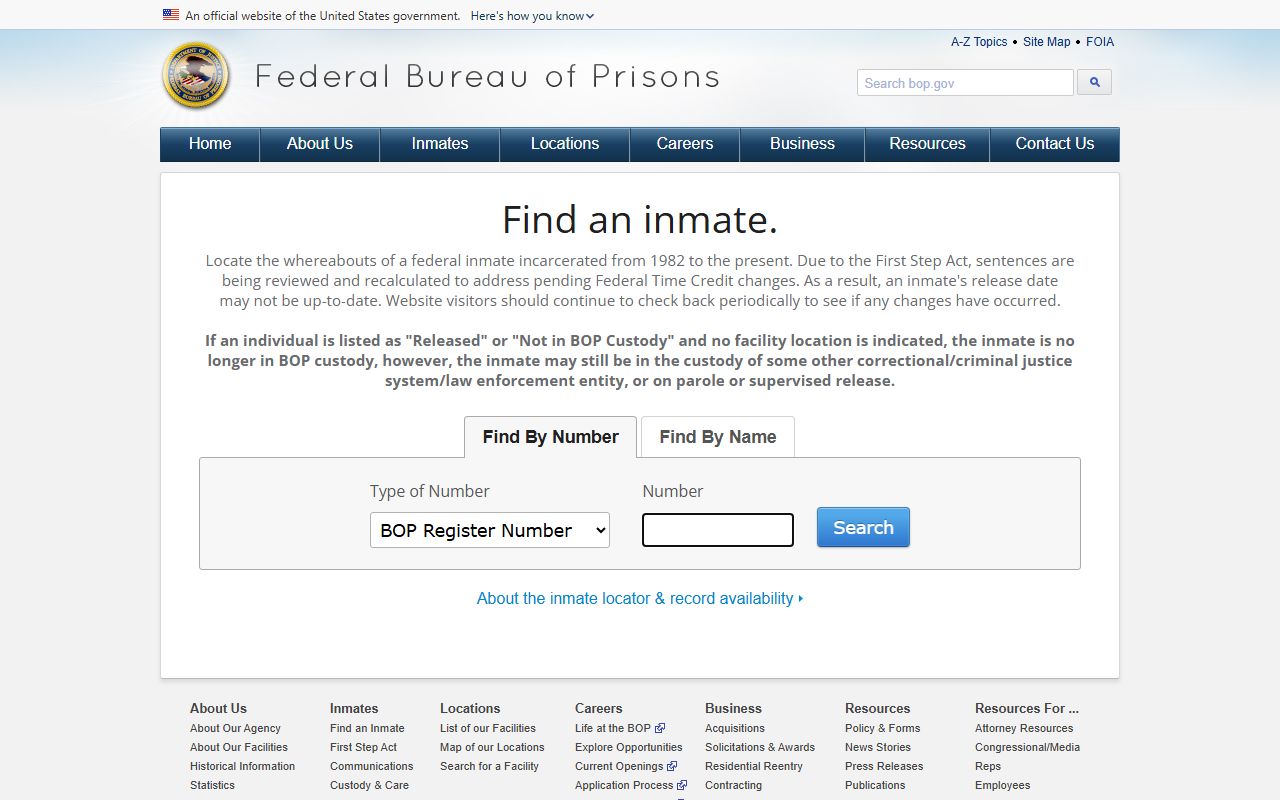
As the locator interface shows, it returns custody and facility data rather than a public booking-photo feed, which is why federal cases are handled outside the county channel. State prison photos are separate again. When a Nassau County defendant is sentenced to state prison, the Florida Department of Corrections becomes the source. Its statewide offender search carries the inmate photo on the detail page, but that is a prison photo of a sentenced inmate, not a county jail booking photo. The correct routing stays simple: NCSO for recent local custody, FDC for state prison, and BOP for federal prison.
Booking Photos and the Court Record
A booking photo and a court record are not the same thing, and people often confuse them. The photo and the roster charges come from the arrest. The court charges come later, after the State Attorney's Office for the Fourth Judicial Circuit reviews the case and decides what to file. Those formal charges can differ from the booking charges, and they may be amended, reduced, dismissed, or resolved by plea or trial as the case moves.
To follow what happened after the arrest, you search the court file rather than the jail roster. The Nassau County Clerk's sealed and expunged records page explains how a case file can become non-public, which is the legal status that controls long-term access to the record behind a photo. For a deeper look at the booking and custody side of an arrest, the Nassau County jail inmate records page covers how the roster and the records request process fit together.
Reviewing the clerk's own guidance helps separate what stays public from what a court can restrict.
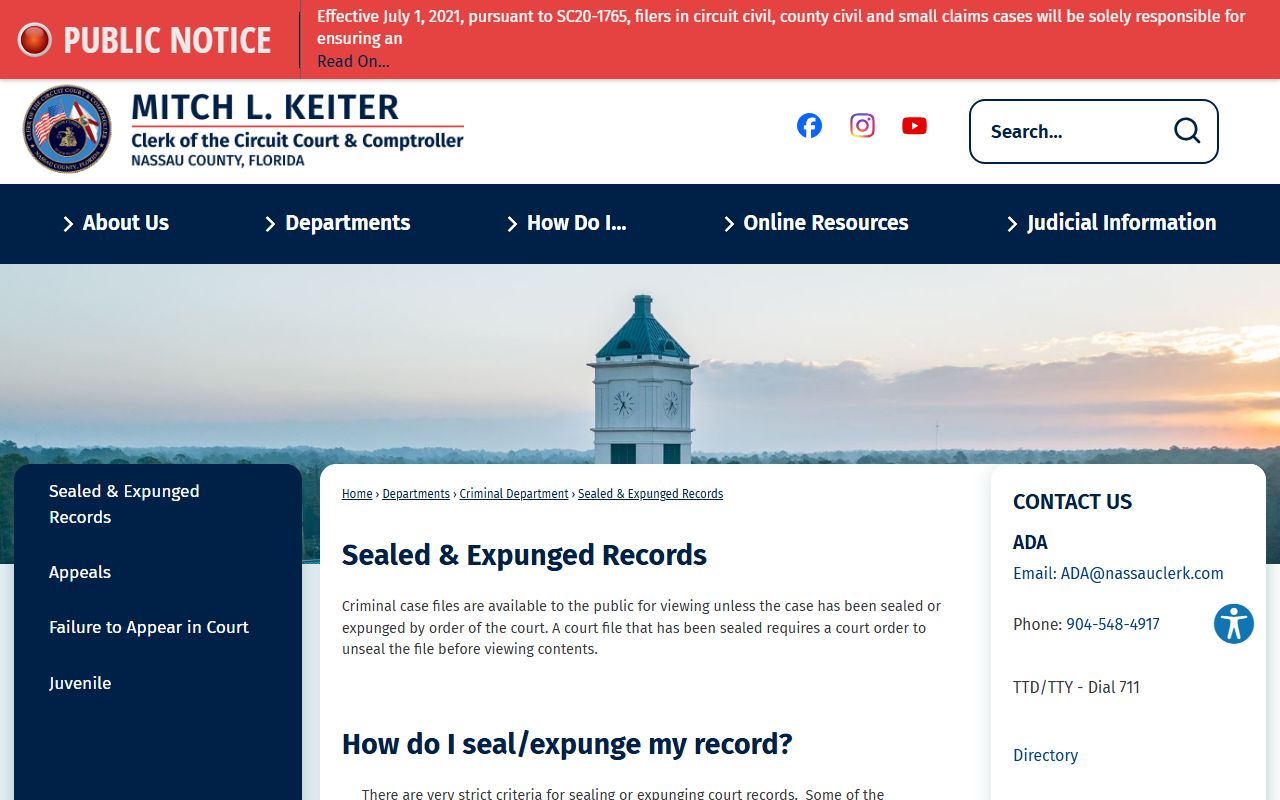
The clerk's page makes the distinction plain: criminal case files remain public unless a judge seals or expunges them, which is the route that affects whether a booking-related record stays open to the public. That court process, not a takedown demand to a private website, is the dependable way to limit the long-term reach of an arrest record in Nassau County.