
Nassau County Court Records After a Jail Arrest
An arrest in Nassau County is only the first step. After a person is booked at the jail, the case goes to the State Attorney's Office for Florida's Fourth Judicial Circuit, which serves Duval, Clay, and Nassau counties. Prosecutors read the law-enforcement reports and decide what formal charges to bring. Once a charge is filed, a criminal case opens and the Nassau County Clerk of the Circuit Court begins keeping the court record. That file, not the arrest itself, is where charges, hearings, and outcomes live. So the court records after an arrest are the durable public account of the case.
The booking side and the court side answer different questions. To see whether someone is still in custody and what bond was set, the jail inmate records page covers the sheriff's roster, and the jail mugshots page covers booking-photo questions. The court record is separate. It shows the charges the prosecutor actually filed, which can differ from the charges written on the arrest report, plus every docket entry the judge and clerk add as the case proceeds. Reading both sides together gives the full picture of an arrest and the case that follows.
How to Find Nassau County Court Records After an Arrest
The Nassau County Clerk maintains the criminal court files and runs the public search tool. The Clerk's Records Search page links to the OCRS court records search through the CiviTek system, where charges and charge status appear once a case is filed. Many records the office keeps are available remotely, subject to privacy rules and case status. Arrest and booking detail stays on the sheriff's jail roster, so the court portal is the place to read the filed charges and the docket, not the immediate custody status.
The Clerk's records-search workflow runs in a few clear steps.
- Open the Clerk's Records Search page and choose the OCRS court records search to reach the case index.
- Search by defendant name or, if you have it, the case number for an exact match.
- Open the case and read the charge list, the docket entries, and any scheduled court dates.
- Check each charge for its statute code, its level (felony or misdemeanor), and its current status.
Most public case information does not require an account. The Clerk explains that publicly available records can be viewed without the user registration agreement. Registration is needed only for unique access to confidential or non-public information, which applies to law enforcement, the State Attorney's Office, attorneys of record, and case parties. Registration may also unlock added search criteria such as date range and case type. To register, a person emails the completed Online Records User Registration Agreement to subscribers@nassauclerk.com, and processing takes one to five business days.
The Clerk's court search is the place to read filed criminal charges in Nassau County after an arrest, as shown below.
The Clerk's online court records search lets the public reach Nassau County criminal case files and dockets.
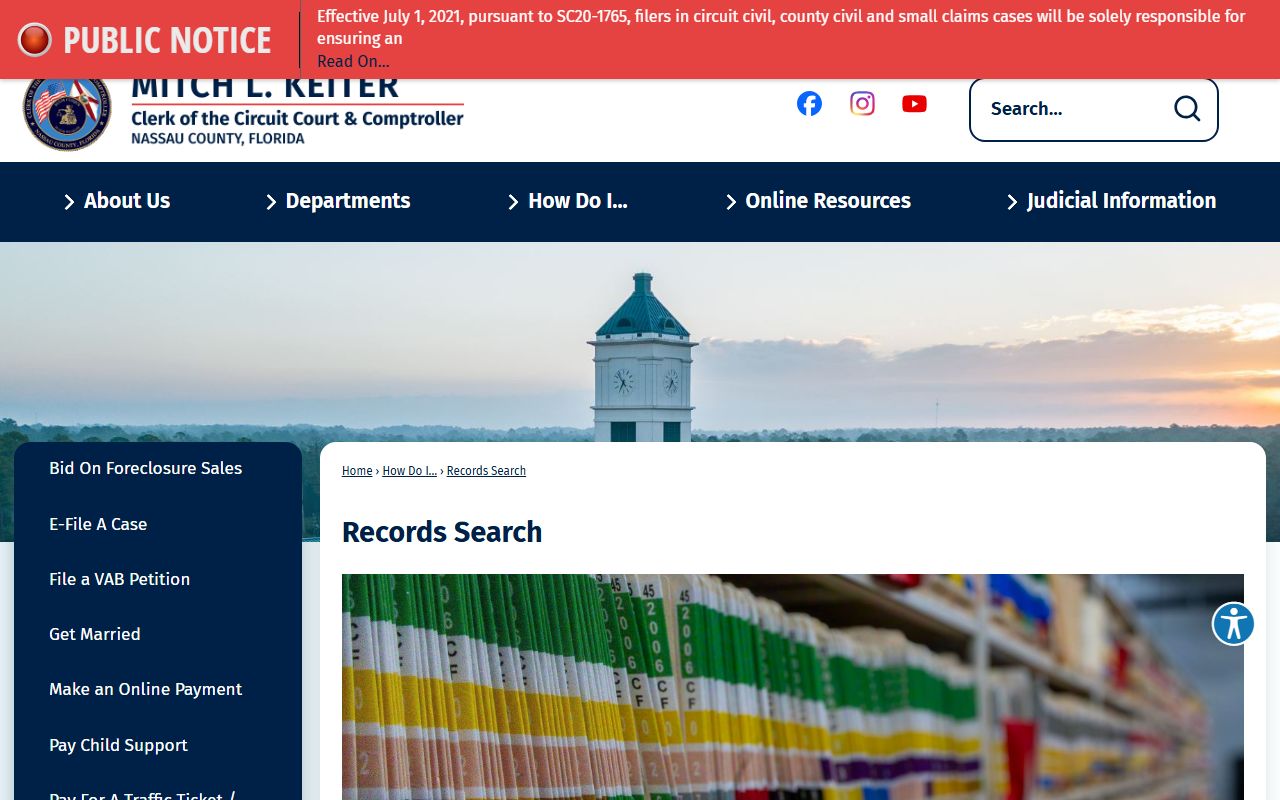
From this page a reader follows the OCRS link to the case index, where the filed charges and docket history for a Nassau County criminal case become visible without an account for most public records.
Which Court Holds the Records After a Nassau County Arrest
Nassau County criminal cases split between two trial courts, and the court records after an arrest sit in whichever court matches the charge. The Clerk's Criminal Department keeps the files and collects the fines, fees, and assessments for every criminal case filed in the county.
Circuit Court handles the most serious matters. That includes felonies, crimes punishable by a term in state prison, serious traffic offenses such as fleeing law enforcement, repeat DUI charges, habitual driving while license suspended, and juvenile delinquency violations. County Court handles the lower-level caseload, which covers misdemeanors, criminal traffic cases, noncriminal county and municipal ordinances, and infractions. Both courts are part of Florida's Fourth Judicial Circuit, and both feed their records into the same Clerk index that the public can search.
The Clerk's Criminal Department page explains how felony and misdemeanor cases are handled and where seal and expunge questions go.
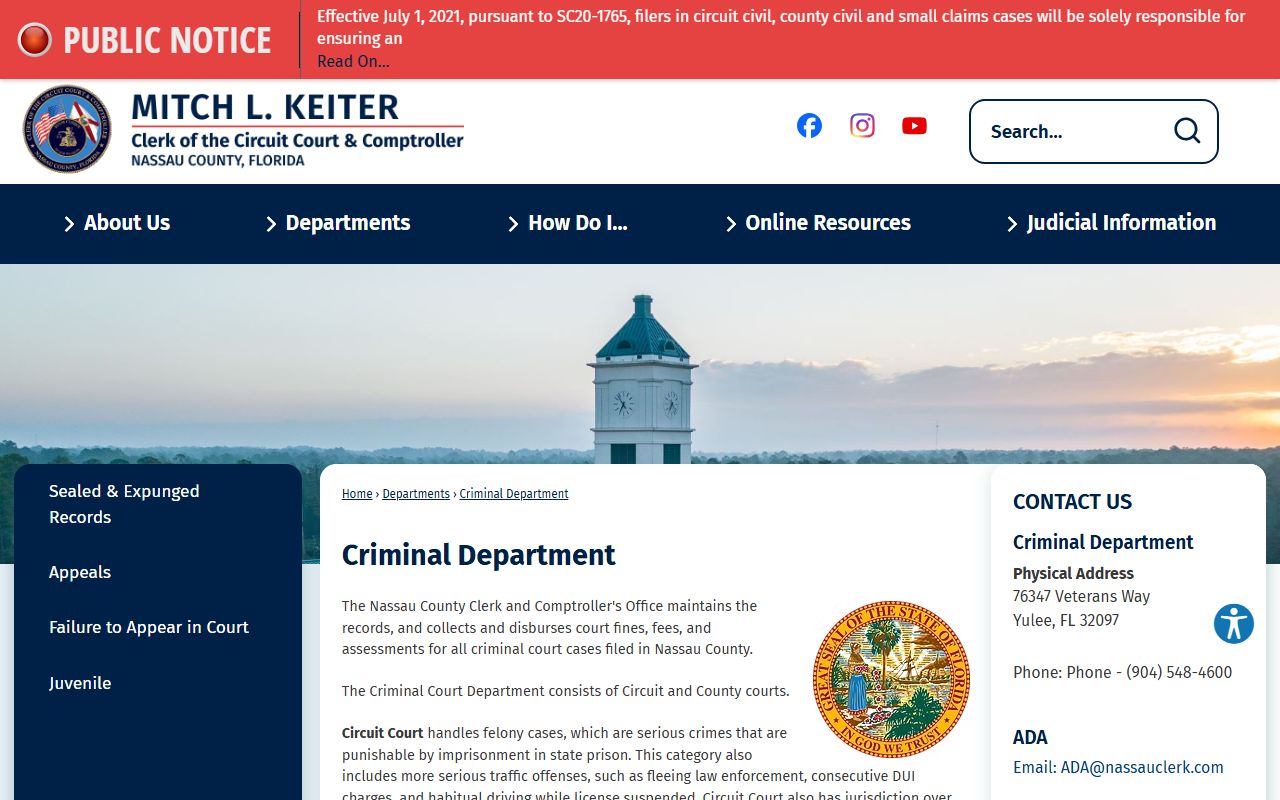
The page confirms the Circuit Court and County Court divide and points readers to Criminal Customer Service for sealed or expunged case packets, which keeps the court record path clear from the moment charges are filed.
Who Files the Charges After a Nassau County Arrest
The arresting agency books a person, but the prosecutor decides the charges. In Nassau County that prosecutor is the State Attorney's Office for Florida's Fourth Judicial Circuit, led by State Attorney Melissa W. Nelson. The office serves Duval, Clay, and Nassau counties and reviews law-enforcement reports before filing. This review is why the charges on a court record can look different from the charges on the arrest report.
The State Attorney's Office for the Fourth Judicial Circuit describes the elected State Attorney and the team that handles County Court and Circuit Court cases.

Because the State Attorney files the formal charges, the court record reflects the prosecutor's decision rather than the field arrest. A felony moves into Circuit Court, while a misdemeanor or criminal traffic charge generally moves into County Court, and the Clerk opens the file once the charge is filed.
How Charges Get Filed After an Arrest: Complaint, Information, and Indictment
The court record begins with a charging document. After booking at the jail, the case does not become a court file until a formal charge is filed, and three documents can do that job. The type used depends on the seriousness of the charge and the procedure that applies. Each one opens the case and sets what the defendant must answer.
| Complaint | Information | Indictment | |
|---|---|---|---|
| Filed By | Officer / Prosecutor | Prosecutor (State Attorney) | Grand Jury |
| Common For | Misdemeanors | Many felonies | Serious felonies |
| Starts | The case | The case | The case |
In most Florida felony cases, the State Attorney files an information after reviewing the evidence. A grand jury indictment is reserved for the gravest charges. Whichever document is used, it is the event that turns an arrest into a searchable court record in the Clerk's index.
Charge Status in Nassau County Court Records
Charges are not fixed once a case opens. As the case moves, the prosecutor can amend, reduce, add, or drop charges, and a judge can dismiss them. This is also why the booking charges shown on the jail roster can differ from the charges the prosecutor finally files. The docket in the court record tracks each change, so the status field tells a reader where a charge actually stands.
| Status | What It Means |
|---|---|
| Pending | The charge has been filed and the case is still open, with no final outcome yet. |
| Amended / Reduced | The prosecutor changed the charge, often to a lower level, after reviewing the case. |
| Dismissed | A judge ended the charge, so it does not proceed to trial or sentencing. |
| Nolle Prosequi | The prosecutor chose to drop the charge and not pursue it further. |
Note: Booking charges reflect the arrest, while the court record reflects what the State Attorney filed, so confirm the current status in the Clerk's case docket rather than the roster.
Bond and Release After an Arrest
Bond decides whether a person waits for court in custody or out. At first appearance a judge reviews custody and sets bond conditions, and the court record carries those conditions and any later changes. The jail roster shows the immediate custody and bond status, while the court docket shows the formal orders. The Sheriff's Office handles the money side of release at the jail under specific rules.
| Bond Type | How It Works |
|---|---|
| Cash Bond | The full bond amount, paid at the jail by certified or cashier's check from a local bank or by money order to the Nassau County Clerk of Courts; no cash or credit cards. |
| Surety Bond | Posted through a licensed bonding agency; deputies cannot recommend or advise on choosing a bondsman. |
| PR / Own Recognizance | Release on a written promise to appear, set by the judge, without paying a money bond. |
| No-Bond Hold | A status where paying a standard bond will not release the person, often after a failure-to-appear warrant. |
A purge payment works differently from a bond. If a person is held on a civil charge such as a writ of attachment, the judge may set a purge amount that must be paid for release. The purge is paid at the jail by certified or cashier's check or money order, but the payee is the Nassau County Sheriff's Office rather than the Clerk. Holds for another county, the state, federal authorities, or immigration can also block release even when a bond exists.
Warrants That Lead to an Arrest
Many arrests start with a warrant, and the court record often shows why one was issued. A capias or bench warrant frequently follows a failure to appear, while an arrest warrant follows an alleged crime. The Sheriff's Office Warrants Unit handles capiases, arrest affidavits, writs of attachment, custody orders, injunctions for protection, and warrants, and it coordinates transport and extradition with other agencies. Once a person is arrested on a warrant, custody status shifts to the jail roster after intake is complete.
Checking for a warrant in Nassau County takes more than a phone call. The Sheriff's Office will not release outstanding warrant information to the public over the phone. Warrant information must be obtained in person or by contacting the Criminal Division at the Nassau County Courthouse. The court record can still show a failure to appear, a capias, a bond forfeiture, and upcoming court dates after a case is filed, so the Clerk's docket is a useful place to confirm a court-issued warrant tied to an existing case.
Charges vs. Convictions in Court Records
An arrest and a charge are accusations, not findings of guilt. A person can be arrested, charged, and still have the case dismissed or end in an acquittal. The court record shows both the charge and the eventual outcome, so reading it carefully matters. Confusing a filed charge with a conviction is one of the most common mistakes when reviewing court records after an arrest.
| Charge | Conviction | |
|---|---|---|
| Stage | Accusation | Verdict or plea |
| Burden of Proof | Probable cause | Beyond reasonable doubt |
| Public Record | Yes | Yes |
A charge can be pending, amended, reduced, dismissed, dropped by the prosecutor, resolved by a plea, or resolved at trial. A conviction is a final adjudication, which is a different entry entirely. State prison custody also follows only a felony conviction with a prison sentence, and those records appear in the Florida Department of Corrections system rather than the county jail roster or the county court file.
Sealed vs. Expunged Court Records After an Arrest
Some people can clear a record after a dismissal or an eligible outcome. Criminal case files in Nassau County are public unless a court orders them sealed or expunged. Sealing and expunging are not the same, and the difference controls who can still see the record. Both run through a court order and involve the state as well as the Clerk.
| Sealed | Expunged | |
|---|---|---|
| Visibility | Hidden from public view; a court order is needed to unseal it | Destroyed or treated as if it never existed in public form |
| Law Enforcement | Limited access remains | Very limited access remains |
| Eligibility | Set by Florida court rules and certain statutory criteria | Set by Florida Statutes §943.0585 and related rules |
The process touches more than one office. The Nassau Clerk provides sealed and expunged packets through Criminal Customer Service, and the seal and expunge line is 904-548-4613. The Florida Department of Law Enforcement handles the state criminal-history side of the process, and the court-ordered expunction itself runs under Florida Statutes §943.0585. A sealed court file requires a court order to unseal before anyone can view it again.
What the Clerk Can and Cannot Do
The Clerk keeps the records but does not give guidance on a case. Under Florida law and the Clerk's own rules, deputy clerks cannot provide legal advice, and they cannot excuse a defendant from a court hearing. Once a court date is set on a misdemeanor case, the Clerk's Office cannot change it, and the person must contact an attorney if a problem comes up.
Failing to show up carries real consequences. Failure to appear can lead to an arrest warrant, forfeiture of any posted bond, and possible no-bond custody after the arrest. The court docket records each of these steps, which is one more reason to read the court record after an arrest rather than relying on the booking sheet alone. For records the office holds, the public-records framework under Florida Statutes Chapter 119 sets the broad rule that government records are open unless an exemption applies.
Background Check Considerations
A casual court-record lookup is not the same as a regulated background check. Reading a public docket to follow a case is fine, but using records to decide on a job, a loan, housing, or insurance falls under federal rules. Those formal screenings must come from a consumer reporting agency that follows the Fair Credit Reporting Act, which adds accuracy and notice protections that a quick public search does not.
Important: This site is not a consumer reporting agency under the FCRA, and its information cannot be used for employment, credit, housing, or insurance screening.
Restricted Court Records After an Arrest in Nassau County
Not every court record after an arrest is open to the public. Florida's public-records law makes most criminal case files available, but several categories are kept back. Juvenile delinquency records are far more restricted than adult records, so a juvenile arrest does not appear in the public adult index unless the youth is charged as an adult. Sealed and expunged cases are removed from public view by court order, and certain protected information can be redacted.
Other limits apply during an active case. Records tied to an ongoing investigation can be withheld until the matter is resolved, and exemptions under Florida Statutes §119.0714 govern what stays out of the public court file. When a record is restricted, the right path is the Clerk or the court, not a third-party site, and a sealed file still needs a court order before anyone can view it again.